E-commerce Content Strategy: What 379 Product Keywords Reveal About Ranking in 2026
Most e-commerce content strategy guides say the same things. Start a blog, post on social media, write product descriptions, and make videos. That advice isn’t wrong. It’s just not specific enough to know which to do first or how to prioritize when time is limited.
The key thing to understand before you get started is which types of content appear in product searches in your industry. Is a blog worth the investment? Should you build long-lasting evergreen content, buyer’s guides, or focus on stronger category or product pages? Does video move the needle? The answer varies depending on what you sell.
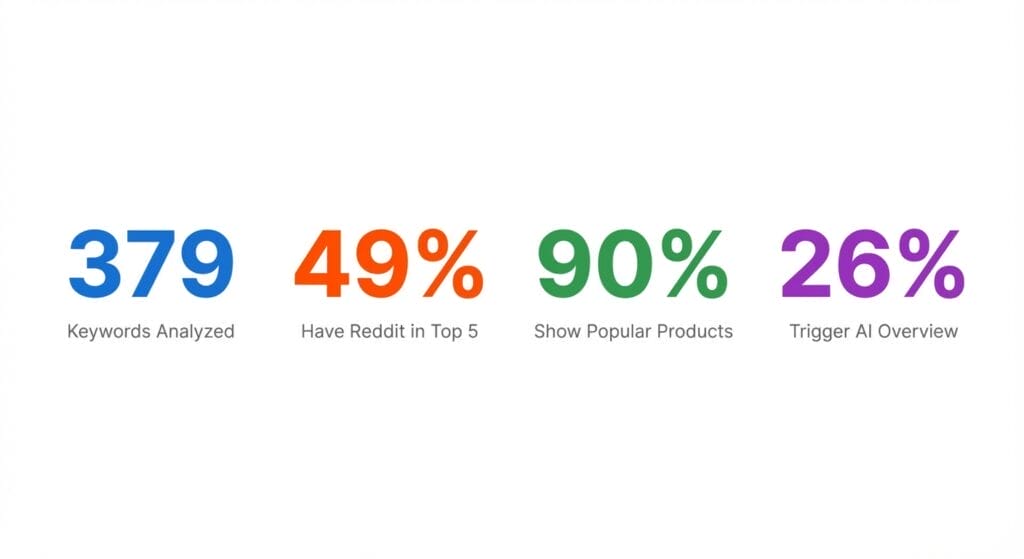
At Garrett Digital, we wanted to see what ranks for product searches across different e-commerce verticals. We analyzed the top 5 organic results for 379 commercial product keywords within six US sectors: outdoor gear, pet supplies, home fitness, beauty and skincare, kitchen and cookware, and auto parts. For each result, we recorded the page type, domain, content depth, and SERP features.
The results challenged several common assumptions. Category pages dominate overall rankings, but not in every vertical. Home fitness behaves more like a publisher market than a catalog market. Reddit appears in nearly half of the top 5 results. And pages ranking first often have lower domain authority than pages ranking fifth.
Below are the findings and how you can use them to build an e-commerce content strategy that fits your market.
How We Analyzed These SERPs
We pulled the top 5 organic results for 379 commercial product keywords using DataForSEO SERP data. Ahrefs provided SEO metrics for each ranking page, including Domain Rating, word count, heading structure, and internal link counts.
Scope:
- 379 keywords across six US e-commerce verticals
- Top 5 organic positions only
- Commercial product intent only (minimum 500 monthly search volume)
- US search market, March 2026
- Social platforms (YouTube, Reddit, TikTok) are included when they appear in organic results
Page type definitions: Each result was classified as a category page, product page, blog/editorial page, or other. Category pages list multiple products with filtering and sorting. Product pages focus on a single SKU. Blog/editorial pages are long-form articles, buying guides, or comparison reviews. “Other” includes brand homepages, forum threads, marketplace listings, and pages that don’t fit the first three categories.
Domain types: Mega-retailers (Amazon, Walmart, Target, Costco), vertical retailers (category specialists like REI, Chewy, AutoZone), review publishers (Wirecutter/NYT, Car and Driver, Byrdie), marketplaces (eBay, Etsy, Wayfair), forum/UGC sites (Reddit, YouTube, Quora), and other (DTC brands, niche shops, independent blogs). The “other” group turns out to be the largest.
Limitations: This is a snapshot in time. We analyzed the top 5 positions, not the full first page. The study covers commercial product terms only, not informational or navigational queries. Vertical sample sizes vary. Results reflect the US market and may differ in other regions.
The Content Mix Changes by Vertical
The data shows there’s no universal answer to “what type of content should I create?”
Category pages account for 43% of position-1 rankings overall. Blog and editorial content holds 23%. But those averages hide dramatic differences across verticals.
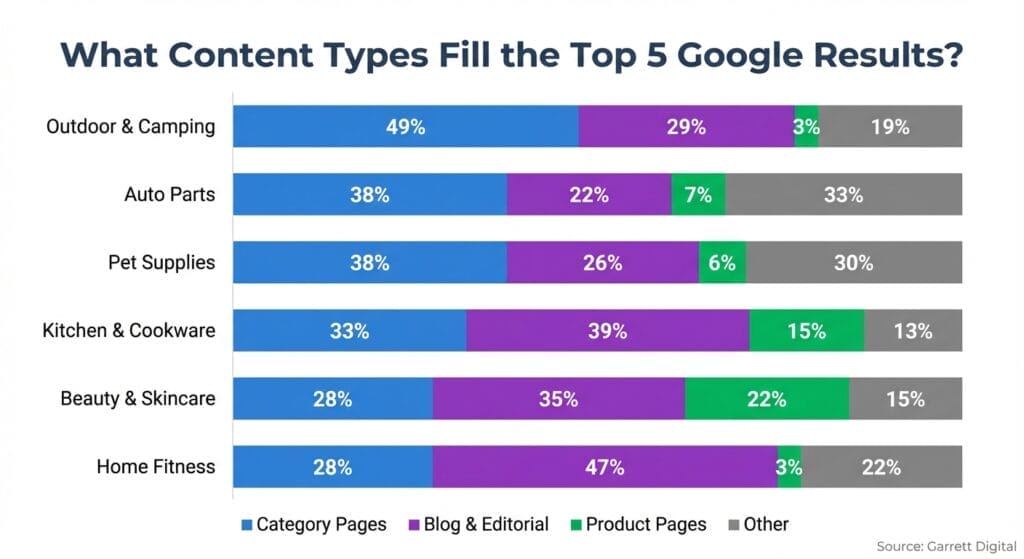
| Vertical | Category Pages | Blog & Editorial | Product Pages | Other |
|---|---|---|---|---|
| Outdoor & Camping | 49% | 29% | 3% | 19% |
| Auto Parts | 38% | 22% | 7% | 33% |
| Pet Supplies | 38% | 26% | 6% | 30% |
| Kitchen & Cookware | 33% | 39% | 15% | 13% |
| Beauty & Skincare | 28% | 35% | 22% | 15% |
| Home Fitness | 28% | 47% | 3% | 22% |
Percentage of all top 5 positions held by each content type.
If you sell outdoor gear, strong category pages are key to visibility, as they occupy nearly half of the top 5 search results. Focus on creating detailed, organized pages with filters, subcategory navigation, pricing, and supporting content.
If you sell fitness equipment, it’s the opposite. Blog and editorial content hold 47% of the top 5 positions, category pages just 28%. Without editorial content, a fitness brand is invisible for nearly half of the keywords potential customers search for.
Beauty sits in the middle, with 35% editorial and 28% category. You need both. Every vertical’s e-commerce content marketing mix includes content types that most brands haven’t built yet: video, comparison guides, and user-generated content, which search engines increasingly reward.
The framework: Start by analyzing the SERPs for your top 50 product keywords before investing in any content. Determine the number of results that are category pages, blog posts, reviews, and product pages. This ratio will serve as your content strategy guide.
If your vertical isn’t listed here, the framework still applies. Pull the SERPs for your top 50 keywords and classify the results. The content mix Google rewards in your market might look like outdoor gear or home fitness. You’ll know once you check.
How Search Intent Changes Which Content Type Wins
Where a keyword falls in the buying journey changes which page type ranks.
For “best X” queries, like “best hiking boots” or “best air fryer,” review publishers hold 45% of position 1 rankings, and category pages nearly disappear. These searchers are comparing options and want expert opinions, not product listings.
For unmodified product terms like “hiking boots” or “air fryer,” category pages and vertical retailers dominate. These searchers are closer to buying and want to browse options with filters, pricing, and product images.
This distinction matters for how you build your content calendar. If most of your target keywords include “best,” “top,” or “vs,” blog and editorial content should be your primary investment. If your keywords are product names and category terms, invest in your category pages first.
Audit your keyword list by intent type before deciding where to spend. A fitness equipment brand targeting “best treadmill” needs editorial content. That same brand targeting “treadmill” needs a strong category page. Both keywords matter, but each requires a different content type to rank.
Blog Content Wins — When It Meets a High Bar
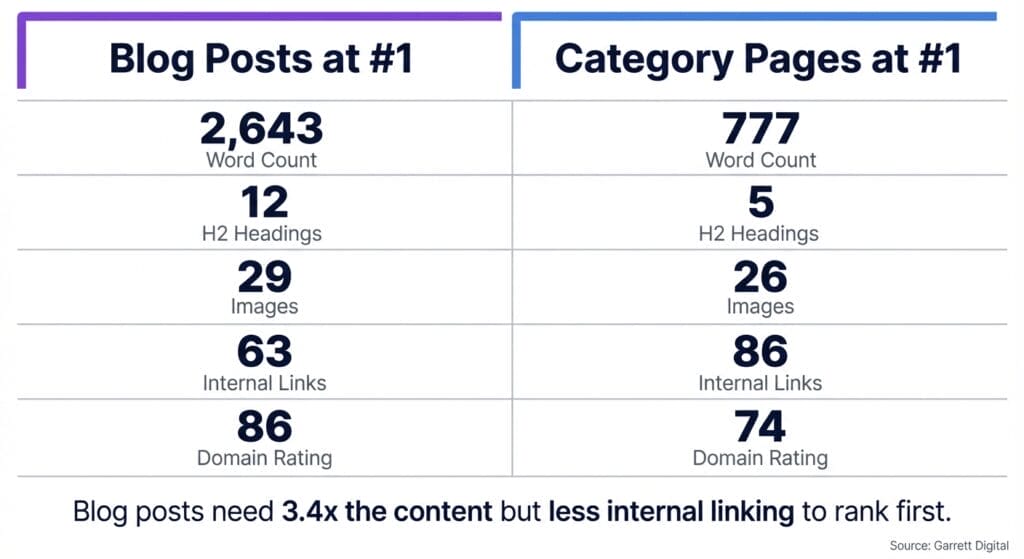
The 23% of #1 positions held by blog content comes with an important caveat: the editorial content that ranks first for product keywords isn’t typical brand blogging.
Position 1 blog content and position 1 category pages look very different:
| Metric | Blog Posts at #1 | Category Pages at #1 |
|---|---|---|
| Median word count | 2,643 | 777 |
| Median H2 headings | 12 | 5 |
| Median images | 29 | 26 |
| Median internal links | 63 | 86 |
| Median Domain Rating | 86 | 74 |
Blog content that ranks first is detailed, well-organized, and published on high-authority domains. The top editorial winners include the New York Times (Wirecutter), Car and Driver, Byrdie, Men’s Health, and Serious Eats.
These are professional editorial operations. They produce expert buying guides, comparison reviews, and product testing with original photography.
This isn’t “7 Tips for Choosing a Yoga Mat.” It’s a 2,500-word review where someone tested 15 yoga mats and provided detailed pros, cons, and recommendations.
If your blog content can’t match that depth and expertise, a stronger category page is the better investment. The data backs this up: category pages that rank #1 need just 777 words, but they need strong internal linking (median 86 internal links) and a lower authority threshold (DR 74 vs. 86 for blogs).
The e-commerce brands winning with editorial content are doing one of three things:
- Publishing genuine expertise. REI’s buying guides, Lodge Cast Iron’s care content, and Chewy’s pet nutrition articles rank because they reflect real product knowledge that generic competitors can’t replicate. This content builds trust with potential customers before they reach a product page. It demonstrates that you understand the category, not just the product you sell.
- Earning coverage from review publishers. Getting your product reviewed by Wirecutter, Serious Eats, or Outdoor Gear Lab puts your brand in front of searchers through content you didn’t have to create. Those pages already have the authority and depth to rank. Focus outreach on the review sites that dominate your vertical’s SERPs.
- Supporting product pages with comparison and guide content. Product descriptions alone won’t rank for broader commercial terms. A product page converts visitors, but a buying guide or comparison post captures them earlier in the search journey when they’re still evaluating options. The two work together: editorial content drives awareness, product pages drive conversions.
Video Is the Strategy Many E-commerce Brands Ignore
YouTube ranks in the top 5 organic results for 11% of commercial product keywords. Google’s video carousel appears in 17% of SERPs.
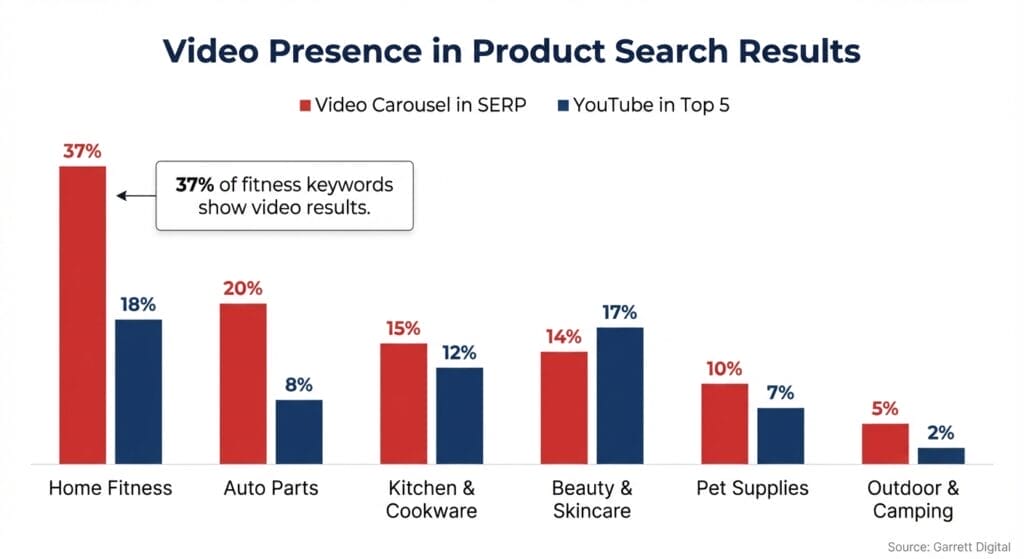
That’s not evenly distributed:
| Vertical | Video Carousel in SERP | YouTube in Top 5 |
|---|---|---|
| Home Fitness | 37% | 18% |
| Auto Parts | 20% | 8% |
| Beauty & Skincare | 14% | 17% |
| Kitchen & Cookware | 15% | 12% |
| Pet Supplies | 10% | 7% |
| Outdoor & Camping | 5% | 2% |
If you sell fitness equipment, 37% of your target keywords show a video carousel, and YouTube holds an organic position for nearly 1 in 5. A YouTube strategy isn’t optional for fitness brands. It’s a primary ranking channel.
Beauty brands see 17% YouTube organic presence. Kitchen and cookware brands see a 12% increase. Those numbers rival or exceed what some verticals see from blog content.
Video serves two purposes at once. It can rank as an organic result on Google and build a separate audience on YouTube. A product comparison video appeals to searchers who want to watch before buying and to those looking for honest opinions before committing.
For brands without the authority (DR 80+) to compete with Wirecutter-level blog content, video is the most accessible path into the top 5. YouTube ranks on its own domain authority. The quality and relevance of your content determine whether your video appears.
Video content created for YouTube can be repurposed for Instagram Reels, TikTok, and other social platforms, extending the reach of a single production investment.
Content created for one channel becomes an asset for others. A product comparison video filmed for YouTube can be embedded in a blog post, clipped for short-form social, and referenced in product page copy. One production session builds assets across your entire content strategy.
SparkToro’s research on how influence happens everywhere found that audiences consume content across social, news, and video channels, then go to Google to search. Your video, social, and editorial presence create the demand that search captures.
Match the format to the search intent. “Best treadmill” triggers video carousels because searchers want to see the product in action. “Brake pads” doesn’t, because searchers want to find and buy the right part. Let the SERPs tell you which content format your customers prefer.
You Don’t Need Massive Authority to Rank
One of the most common assumptions in e-commerce SEO is that you need a high Domain Rating to compete.
Domain Rating is a metric derived from the number and quality of external links pointing at your website. In Google’s early days, links were a vital ranking factor. They still play a role, but their relative importance has decreased as Google has improved at evaluating content quality, relevance, and brand signals.
Glen Allsopp’s research at Detailed shows that 16 major media companies appear on the first page for 85% of product review searches, and their dominance comes from brand recognition and editorial depth, not backlinks alone. Our data tells a similar story from a different angle.
Position 1 pages have a median DR of 74. Position 5 pages have a median DR of 83.
The pages ranking #1 have lower authority than the pages at #5. Google isn’t sorting results by backlink profile alone.
Forty-nine pages with a Domain Rating under 50 hold position 1 rankings in our dataset. These include:
- A cat tree brand (DR 13) ranking #1 for “cat trees for large cats”
- A tofu cat litter brand (DR 16) ranking #1 for “tofu cat litter”
- An aftermarket lighting brand (DR 10) ranking #1 for “led tail lights”
- A hiking content site (DR 21) ranking #1 for “best hiking backpacks”
What these low-authority winners share: extreme vertical focus. They don’t try to rank for everything. They build the most relevant, specific page for a narrow set of product keywords, and that relevance signal outweighs domain authority.
Your DR isn’t your ceiling. If your product pages or category pages are the most relevant, most specific, most useful result for a search, you can outrank sites with 5x your backlink profile. For e-commerce SEO, that means deep product knowledge, strong category organization, and content that answers the exact question your potential customers are asking.
The New Competitors in Your SERPs
Your competition for product search visibility isn’t limited to other e-commerce sites. The search results for commercial keywords in 2026 include players that weren’t a factor five years ago.
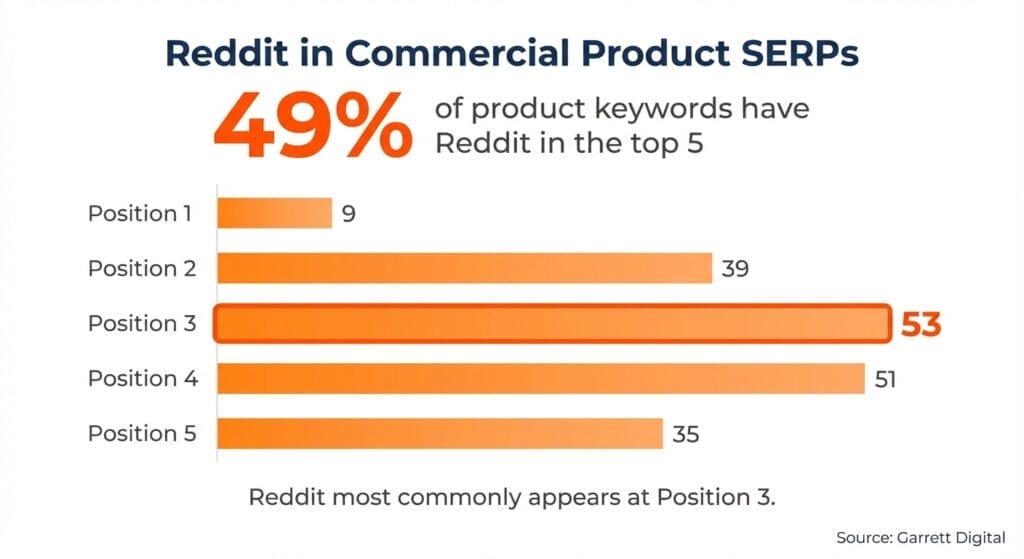
Reddit appears in the top 5 for 49% of commercial product keywords. Nearly half. Reddit ranks #1 for searches like “best adjustable dumbbells,” “best oil filter,” and “korean sunscreen.” Google’s Discussions and Forums feature appears in 36% of product SERPs.
User-generated content is filling the space between category pages and editorial reviews. Reddit threads, customer reviews, YouTube videos, and forum discussions all show up. For searches where Google values authentic opinions, these results outrank product pages, blog posts, and even major publishers.
Google’s Popular Products carousel shows in 90% of commercial SERPs. This free shopping grid, powered by Merchant Center feeds, appears above organic results for nearly every product keyword. If your products aren’t in Merchant Center with accurate titles, images, and pricing, you’re missing the most prominent SERP feature in e-commerce.
AI Overviews and Cross-Channel Visibility
AI Overviews appear for 26% of commercial product queries, and that rate differs by vertical. Auto parts keywords trigger AI Overviews 40% of the time. Beauty and skincare: 34%. Pet supplies: 13%.
AI search tools like ChatGPT, Claude, and Google’s AI Mode tend to reference brands they encounter across multiple sources. Showing up on YouTube, earning visibility in Reddit discussions, and getting reviewed by trusted publications all build recognition. That recognition may help you win across organic search, AI-generated answers, and discovery platforms.
Google’s search results shift over time. SERP features come and go, competitors enter and exit, and algorithm updates reshuffle positions. This study captures a point in time, March 2026, and the specific numbers may shift. The patterns are more durable.
Use this data to prioritize where you invest, not to dictate your entire strategy. A cross-channel approach, where content serves multiple platforms and formats, hedges against changes in any single channel and builds brand equity that benefits everything.
How to Build Your E-commerce Content Strategy From This Data
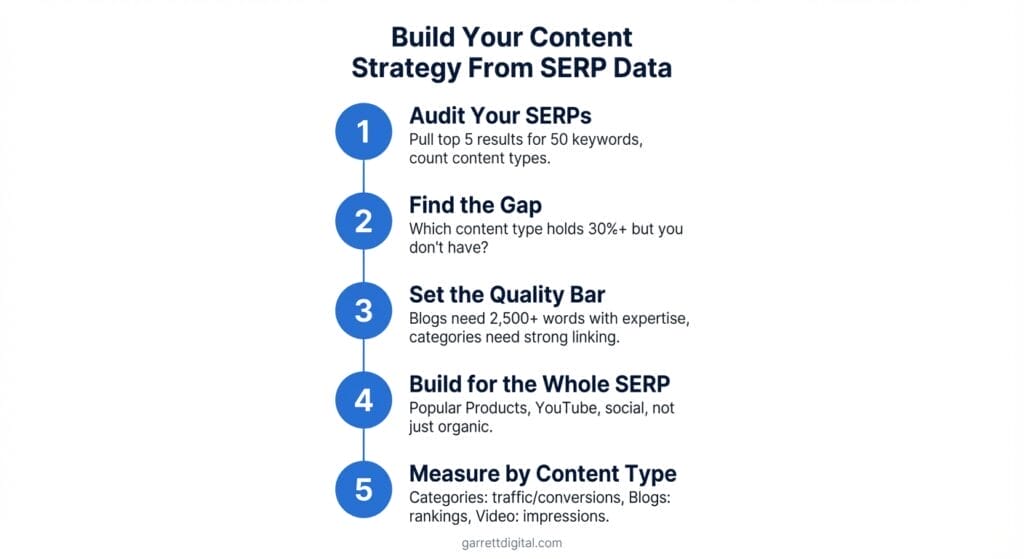
The data points to a five-step framework that works regardless of your vertical, budget, or current domain authority.
Step 1: Audit your SERPs. Start with keyword research to identify your 30-50 most important product keywords. Pull the top 5 results for each. Categorize each result: category page, blog post, product page, video, Reddit thread, or review site. Calculate the percentages. This is the content mix Google rewards in your market, and it’s likely different from what you’d assume.
Search “best air fryer” and you’ll see Wirecutter at #1, a Reddit thread in the top 3, and a video carousel. That tells you editorial content and UGC dominate this keyword, not category pages. Search “air fryer” and you’ll see Amazon, Target, and Walmart category pages filling the top positions. Same product, different intent, different content type needed.
Step 2: Match your investment to the gap. If blog and editorial content hold 30%+ of positions in your vertical and you don’t have any, that’s your biggest opportunity. If category pages dominate and yours are thin, strengthen them first with better product descriptions, filtering, and subcategory navigation. If video shows up in 15%+ of your SERPs and you have no YouTube presence, that’s an untapped channel.
A fitness equipment brand with strong category pages but no blog content is invisible for 47% of the content types ranking in its vertical. That gap is the priority, not more product pages.
Step 3: Set the right quality bar. Blog content that ranks requires 2,500+ words, 10+ structured sections, and genuine expertise. If you can’t commit to creating content at that level, invest in your category pages and product pages instead. They rank with less content but need strong internal linking and a clear user experience. Thin content won’t outrank the editorial publishers who dominate these SERPs.
Step 4: Build for the whole SERP. Make sure your products appear in Google’s Popular Products grid through Merchant Center. It shows in 90% of commercial SERPs and drives high-intent clicks. Consider whether a YouTube video serves your target audience better than another blog post. If Reddit threads rank for your keywords, it signals that Google values authentic user opinions, and your content needs to demonstrate the same credibility through reviews, Q&A sections, and community-driven content.
Step 5: Measure what matters for your content type. Category pages should be measured by organic traffic and purchase conversion rates. Blog content should be measured by rankings, traffic, and the downstream conversions it supports through internal links. Video content should be measured by both YouTube performance and Google search impressions. Each content type has a different path to ROI.
| Content Type | Primary Metrics | Secondary Metrics |
|---|---|---|
| Category Pages | Organic traffic, conversion rate | Revenue per session, bounce rate |
| Blog/Editorial | Rankings, traffic, internal link clicks | Time on page, assisted conversions |
| Product Pages | Conversion rate, revenue | Organic impressions, click-through rate |
| Video (YouTube) | Views, YouTube rankings, Google impressions | Watch time, subscriber growth |
| Product Feeds | Popular Products impressions, click-through rate | Feed approval rate, attribute completeness |
The brands winning e-commerce search in 2026 aren’t following a generic content marketing playbook. They’re auditing their own SERPs, building content types that match, and investing where the data shows gaps, not where conventional wisdom says to spend.
Your e-commerce site doesn’t need every type of content. It needs the right content for your vertical, built to a quality bar search engines reward, and measured by metrics that tie back to conversions. Start with the SERP audit. The data will tell you what to build next.
If you need help building a content strategy for your e-commerce business, contact Garrett Digital.
Study Methodology & FAQ
We analyzed the top 5 organic results for 379 commercial product keywords across six US e-commerce verticals using DataForSEO SERP data and Ahrefs SEO metrics. Below are details on how the study was conducted.
How were the 379 keywords selected? We started with 6-10 broad commercial seed terms per vertical (e.g., “hiking boots,” “dog food,” “air fryer”). Each seed was run through Ahrefs Keywords Explorer to pull matching terms filtered to the US market with a minimum monthly search volume of 500. We pulled up to 50 matching terms per seed, deduplicated across verticals, and trimmed to approximately 65 per vertical.
Were all six verticals evenly distributed? Nearly even. Auto Parts: 65 keywords. Beauty & Skincare: 65. Kitchen & Cookware: 65. Home Fitness: 62. Outdoor & Camping: 61. Pet Supplies: 61.
Was the data from a single SERP pull or averaged across multiple pulls? Single pull. Each keyword was queried once through DataForSEO’s Live Advanced SERP endpoint on March 28, 2026. This is a snapshot, not a longitudinal study. SERP compositions shift over time, which is why we recommend re-auditing your own SERPs periodically.
Were personalization factors controlled? Yes. DataForSEO uses clean browser instances with no logged-in Google account, no search history, and no location personalization beyond the settings we specified: desktop device, Windows OS, US location, English language.
Were featured snippets counted as position 1? No. Featured snippets were tracked separately as a SERP feature flag. Position 1 in our data refers to the first standard organic result. Featured snippets appeared for only 0.3% of keywords in our dataset — essentially a non-factor for commercial product searches.
How were Reddit and YouTube counted when they appeared in both organic results and SERP features? Independently. Organic positions are tracked as URL/domain/position rows. SERP features are tracked as boolean flags per keyword. A keyword can appear in Reddit’s organic position 3 and also trigger the Discussions and Forums SERP feature — both are recorded. The “49% of keywords have Reddit in the top 5” stat refers to organic positions. The “36% show Discussions and Forums” stat refers to the SERP feature.
How were “commercial product keywords” distinguished from informational keywords? Keywords were not pre-filtered by intent. All keywords with volume >= 500 derived from product category seed terms were included. Ahrefs intent flags (commercial, transactional, informational) were recorded as metadata columns. Informational modifiers (“how to,” “best,” “vs”) were flagged but kept in the dataset. Only genuine noise was removed: idioms, anime titles, 3D software terms, crossword clues, and memes — 33 keywords total out of the initial pool.
Full dataset available on request.